You've got a 17th-century folio with a spine that's barely hanging on, or maybe a 1920s edition with foxing spots eating into the margins. The initial impulse is to grab tape—please, don't. That's the fastest way to turn a collectible into a paperweight. Real repair work for an ancient collection is less about "fixing" and more about slowing down entropy, and the tricks that matter are the ones that respect the original materials.
First, know when not to touch
The single most important trick I've learned is restraint. If that antique Bible has a detached board but the sewing structure is intact, your job isn't to glue it back with whatever white paste you find at the office supply store. The trick is to create a custom cradle or box that holds the board in place without adhesive. I use archival-grade four-flap enclosures made from acid-free board. The book breathes, the board stays aligned, and no irreversible glue is involved. One collector I know used this approach on a first-edition Audubon that was shedding its cover—the piece retained its value because a future conservator could still work on it cleanly.
The tradeoff here is obvious: making those enclosures takes time and precise measuring. If you're impatient or just want it "looking whole" fast, this trick feels maddeningly slow. But patience is literally the currency of preservation.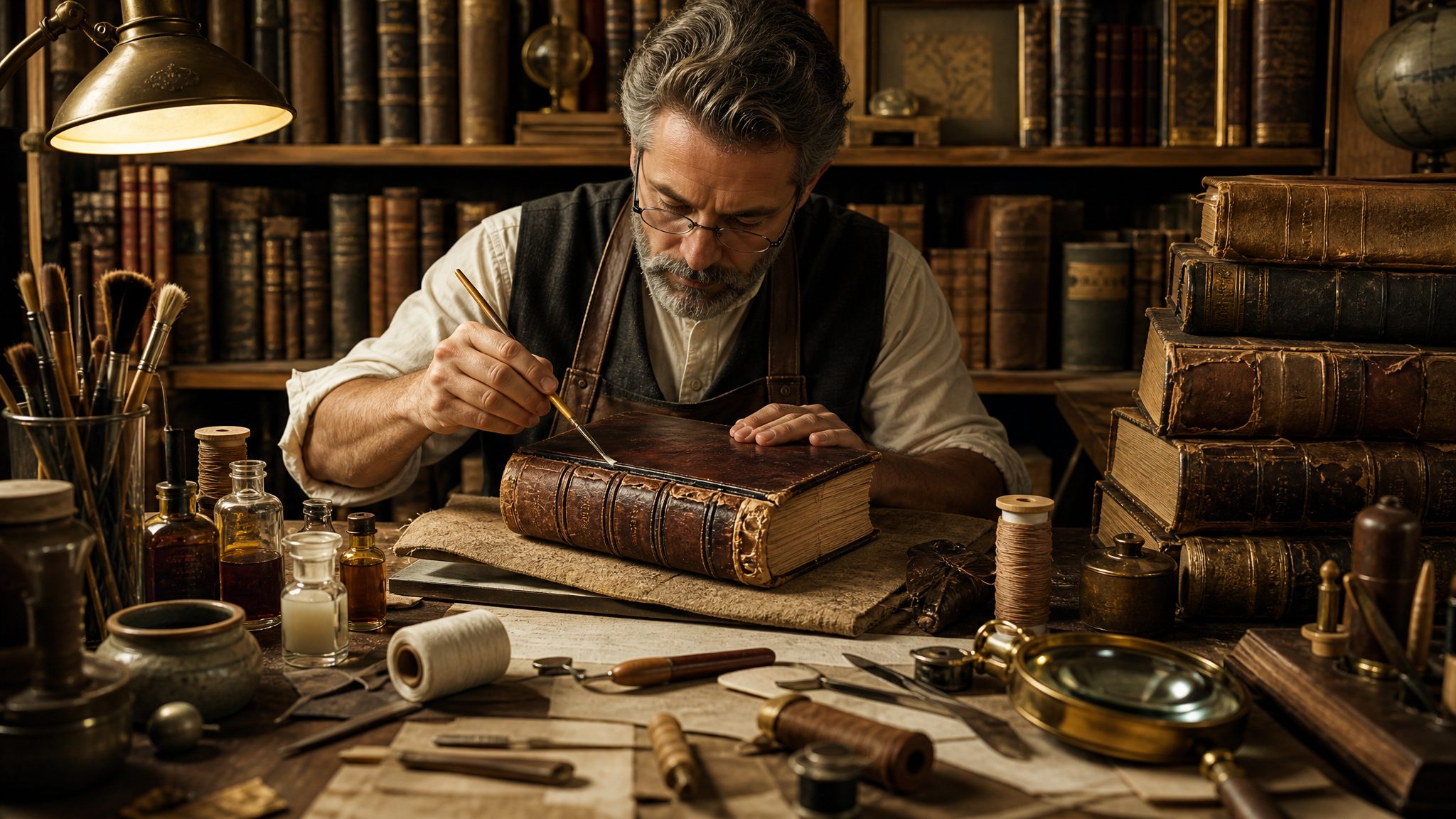
The real work: cleaning and stabilising text blocks
Dust and grime are your enemy because they retain moisture. A soft brush (Japanese hake brush, not a paintbrush) for dry cleaning works better than any eraser product. For stubborn dirt on edges, I use a grated white vinyl eraser—crumbly, not abrasive. You brush it over the text block edges, then vacuum gently with a low-suction museum tool. The trick is to work from the spine outward, so particles don't get forced into the crease.
I learned this the hard way after using a standard eraser on a 19th-century journal and leaving a sheen on the paper. The vinyl eraser leaves no residue, but you have to vacuum carefully. That's the gritty reality: every tool has a learning curve.
Document what you've got before you repair
This is where digitizing comes into the picture. Before I touch a single page—especially if it has handwriting, marginalia, or fragile text—I scan or photograph the document at high resolution. I use Docly here because it extracts text from those scans, even from irregular fonts or faded passages, so I have a searchable record of what the original said. This matters because old books sometimes lose ink during cleaning, and having a text extraction backup saves months of regret.
Docly also lets me annotate the PDF with repair notes—which tear I fixed, what adhesive I used, where the original sewing is visible. One practical scenario: I worked on a 1910 botanical manual that had water damage on the lower third of every page. By scanning and text-extracting before cleaning, I captured species names that were nearly invisible afterward. The PDF became a reference I could search, while the physical book went from soggy to legible.
The tradeoff: which repairs are worth the risk
Not every book in your collection should be repaired. A very worn late-edition reprint with no historical significance? Maybe just store it flat. A unique manuscript copy of a local history? That's where you invest time and effort. The trick is evaluating the binding structure honestly: if the paper is brittle (brown, cracking at the edges), any manipulation will cause more damage. I keep a "no-touch" shelf for books that are too fragile to leaf through. They get digitized fully, then put into inert polyester sleeves and stored in a cool, dark place. The physical object becomes a treasure you look at, not work on.
This takes discipline because the collector's instinct is to "save" everything. But forcing a repair on brittle paper is like stitching a wound on a corpse—it's not healing, it's rearrangement. You're better off preserving the information through text extraction and leaving the physical object undisturbed.
Final practical note
Build your ancient collection's beauty by doing less, not more. Clean gently, support detached parts without glue, and digitize thoroughly before any intervention. A set of good brushes, acid-free enclosures, and a tool like Docly for documentation and text extraction will serve you better than a shelf full of adhesives. The stunning collection is the one that's still readable, still intact a decade from now—and that comes from knowing exactly where to stop.
Comments
Leave a Comment