If you've spent time hunting for older Chinese texts — classical poetry collections, Republican-era novels, pre-1949 academic journals — you already know the frustration. Some titles exist only in overseas university archives. Others were digitized decades ago in formats that are barely readable today: scanned PDFs with no text layer, degraded image quality, and zero searchability.
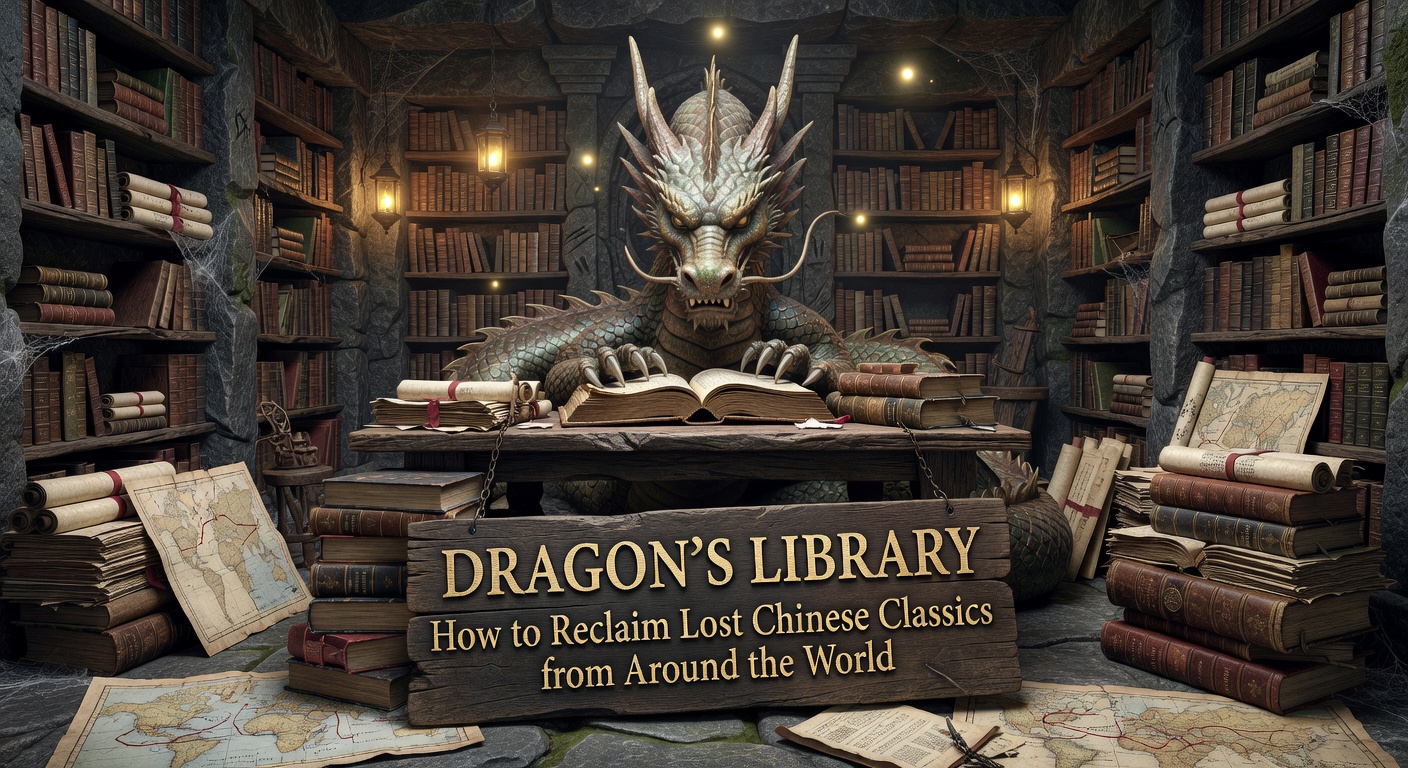
Dragon's Library is one of the more serious attempts to aggregate these scattered sources. It pulls from collections held in Taiwan, Japan, the US Library of Congress, and various European sinology libraries — materials that never made it onto mainland platforms like CNKI or Zhongguo Zhiku.
What You're Actually Getting
The core value here is access to documents that are genuinely hard to find in one place. Think Ming and Qing dynasty local gazetteers, early 20th-century periodicals, and classical commentaries that were out of circulation for decades. For researchers, genealogists, or anyone doing serious historical work, that's meaningful.
But access alone doesn't solve the usability problem. A lot of these files arrive as image-based PDFs — essentially photographs of old pages. You can download them, but you can't search inside them, copy a passage, or run them through a translation tool without extra steps.
Where a Tool Like Docly Becomes Relevant
This is where Docly PDF Tools fits into the workflow. Once you've pulled a document from Dragon's Library, Docly can run OCR on scanned pages, extract the actual text, and generate a summary of what the document covers — useful when you're trying to decide whether a 300-page gazette is worth reading in full.
A few concrete situations where this combination works well:
- You download a scanned Republican-era journal and need to find specific names or dates without reading every page
- You're working with classical Chinese text and want a plain-language summary before committing to a close read
- You need to extract a passage for citation but the PDF has no selectable text layer
It's not a perfect pipeline. OCR accuracy on older printed Chinese — especially pre-simplified characters or damaged pages — varies. Dense classical text with unusual characters will still produce errors that need manual correction.
Tradeoffs Worth Knowing
Dragon's Library doesn't have everything. Coverage is uneven depending on the source institution, and some collections are only partially digitized. If your target text is obscure enough, you may still end up contacting a library directly.
On the Docly side, the AI summary feature works better on structured documents than on literary or classical texts. A summary of a historical essay will be more useful than a summary of a poem anthology — the latter tends to flatten nuance in ways that aren't helpful for scholarly work.
For readers who just want to browse classical Chinese literature casually, free platforms like Ctext.org or Wikisource's Chinese collection may cover enough ground without requiring any additional tools. Dragon's Library plus Docly is a more serious setup, better suited to people who regularly work with primary sources in PDF form.
If that's your situation, the combination is practical. Download, extract, summarize, annotate — it cuts the time spent on document prep significantly, which is usually the least interesting part of the work anyway.
Comments
Leave a Comment