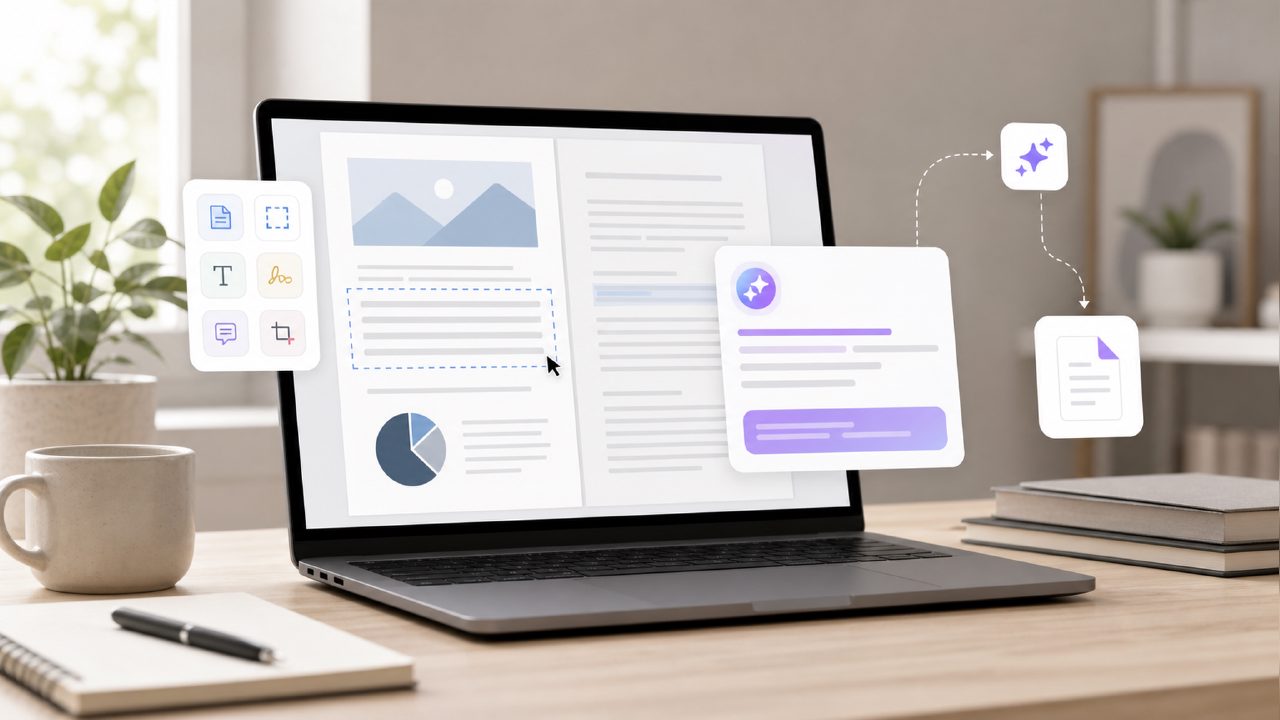
If you deal with a lot of PDF files every week, you probably already tried three or four different tools just to get through the day. One for scanning, one for extracting text, maybe another for summarizing long reports. That’s exactly why I started looking for something that bundles those steps together without feeling like a half‑baked collection of features. The tool I ended up testing most seriously was docly, an AI PDF editor that promises summaries, text extraction, and inline editing in one place. After using it for a few weeks, here are the answers to the most common doubts people have about an all-in-one PDF 工具.
Can docly really summarize a 50‑page report in seconds?
Yes, but the quality depends on the document structure. I fed docly a dense academic paper with tables, footnotes, and two columns of text. The summary it returned was concise — about three paragraphs — and it correctly identified the main thesis and key findings. However, it skipped a few technical details I would have included. For a quick overview before a meeting, it works well. For deep research, you’ll still want to skim the original. It’s a time‑saver, not a replacement for reading.
How accurate is the text extraction from a scanned document?
I tested docly with a poorly scanned invoice from 2019 — low contrast, slightly skewed. The OCR handled it better than I expected. It caught all the line items and the total amount. There were two small typos in a product code (a “1” read as “I”), but nothing that broke the meaning. For clean scans or digital PDFs, the extraction is nearly flawless. The ai pdf scanner and editor free angle is real: you can scan a paper doc with your phone, upload it to docly, and extract the text without re‑typing anything. Just double‑check numbers if precision matters.
Is the AI editing feature useful for everyday work?
It depends on what “editing” means to you. I mostly wanted to delete repetitive sections and rewrite a few sentences in a contract draft. Docly’s AI editor lets you highlight text and ask it to rephrase or shorten. The results were passable — about 80% of the rewrites were usable as‑is. The remaining 20% needed manual tweaking because the AI changed the tone slightly. It’s not a polished word processor replacement, but it beats extracting, editing in Word, and re‑exporting. For quick adjustments inside the document, it’s genuinely faster.
How does the free version compare to the paid one?
I’ll be honest: the ai pdf editor free tier on docly is generous for occasional use. You get a limited number of summary requests per month and basic text extraction. The paid plan adds more summary credits, larger file uploads, and the full AI editor. For a student or someone who just needs to handle a few documents each week, the free version covers the essentials. For a professional who processes dozens of PDFs daily, the paid tier becomes necessary. The limit is clear, and docly doesn’t hide it behind confusing paywalls.
Is docly actually better than using separate free tools?
There are plenty of standalone free ai pdf summarizer 2026 options and separate OCR tools out there. What docly does well is keep everything inside one interface. I used to switch between three browser tabs and two desktop apps just to go from a scanned PDF to a clean editable document. With docly, I can scan, extract, summarize, and copy the final notes without leaving the page. The trade‑off is that no single feature in docly is the absolute best in its category. The OCR isn’t quite as robust as dedicated high‑end scanners, and the summarizer sometimes misses nuance. But for the convenience of a unified PDF 工具, those trade‑offs feel acceptable.
What should I watch out for when using docly?
A couple of things. First, formatting in complex PDFs (like newsletters with multiple columns or decorative borders) can confuse the AI editor. It occasionally merges text from different columns. Second, there’s a learning curve with the editing commands. You have to phrase your requests clearly — “shorten this paragraph” works better than “fix this”. Third, if you rely on the ai pdf scanner and editor free feature, make sure your scan resolution is at least 300 DPI. Lower resolution images produced noticeably worse OCR results in my tests. These aren’t deal‑breakers, but they’re worth knowing before you count on it for urgent work.
For my daily use — reading research papers, editing short contracts, and turning meeting handouts into searchable notes — docly earns its place. It’s not perfect, but it’s practical. If you spend a lot of time wrangling PDFs, it’s worth trying the free tier first, even just to see which tasks it makes easier. That alone saves more time than chasing five different free tools.
Comments
Leave a Comment