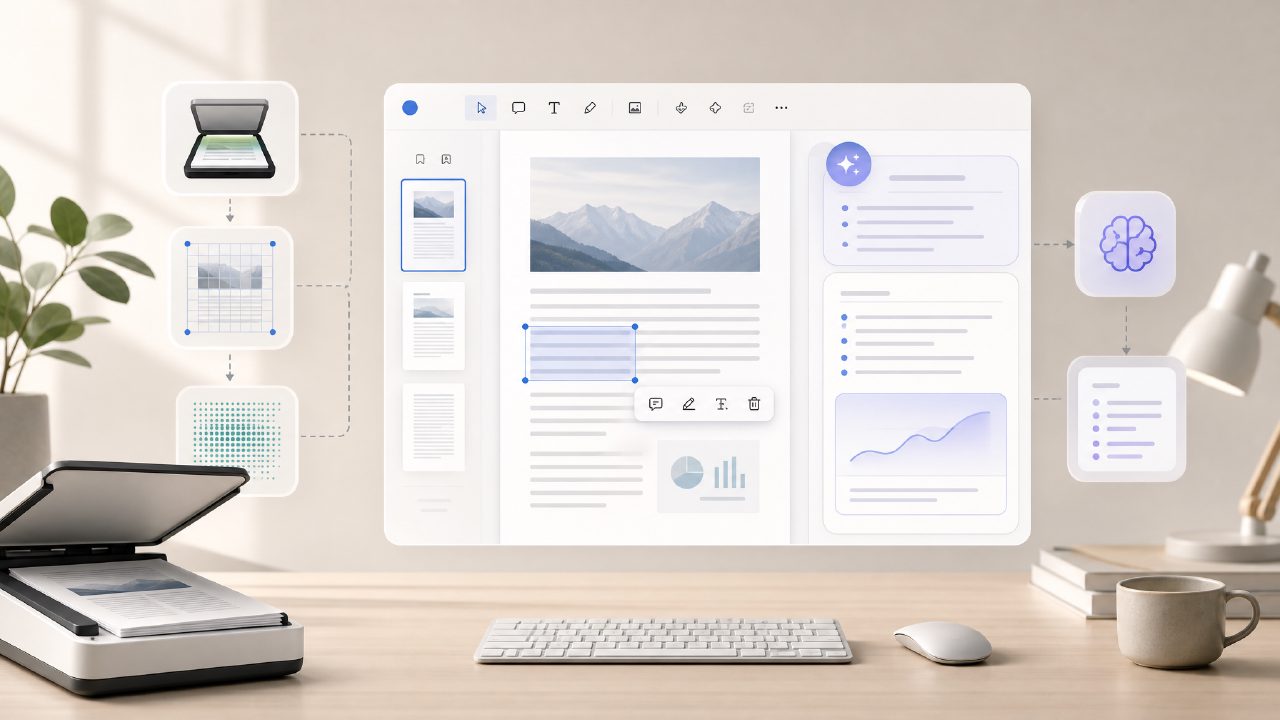
What exactly does this AI PDF editor do—scan, OCR, summarize, edit?
If you’re looking for an ai pdf editor ocr scan summarize edit tool that actually does all those things without sending you down a rabbit hole of subscriptions, docly is worth a close look. I tested it with a few real-world documents: a printed contract I photographed on my phone, a dense academic paper, and an old scanned invoice I needed to edit. The first thing I noticed is that the OCR step isn’t just tacked on—it handles skewed pages and mixed fonts surprisingly well. The scan-to-text part worked for that phone photo, though it did stumble a bit on a highlight mark that covered a date. The summarization feature isn’t a generic paragraph shrinker; it tried to pull out action items from the contract, which was useful even if it missed one clause. Editing directly on the PDF after OCR is where it starts to feel like a proper editor rather than a toy.
Is docly really the best free AI PDF editor in 2026?
Let’s be honest: “best” depends on what you need to do for free. The free tier of docly gave me enough to test OCR, summaries, and basic edits. But there’s a file size cap—my 50-page scanned report was too big for the free version, which was mildly frustrating. For single-page docs or short contracts, it’s genuinely useful. I compared it against two other free tools, and docly’s summary felt more coherent than the competition. But if you’re after heavy editing (like moving images, rewriting whole paragraphs), the free version feels limited. I’d say it’s a strong candidate for best free ai pdf editor 2026 mainly for people who need quick text extraction and summarization without paying. Just don’t expect to batch-process hundreds of pages for free.
How well does the OCR actually work?
I scanned a faded receipt from 2019. Docly picked up most of the text, but the “total” amount was misread—144.50 became 144.5O, which is a typo I had to correct manually. That’s realistic for any OCR tool on low-quality scans. On a clean printed page, it was nearly flawless. The OCR also preserves layout fairly well, so if you scan a two-column article, the text stays in columns rather than jumbling everything together. I’d say it’s good for regular use but not perfect for heavily damaged documents. One mild friction: the scan-to-edit pipeline requires a re-upload in some cases, which feels a bit clunky.
Does the AI summarizer actually save time, or is it fluff?
I fed it a 20-page report on quarterly sales. The summary came back as three paragraphs with bullet points. It captured the main trends and flagged the revenue drop, but it missed a specific footnote about regional adjustments. That’s a tradeoff you have to accept: you still need to skim the original if details matter. For getting the gist fast, it saved me about ten minutes. I also tried it on a legal memo, and the AI neatly separated “key findings” from “action items.” That felt genuinely useful, though the tone was a bit formal—I’d still rephrase key sentences before using them in an email. Overall, it’s a time-saver, not a replacement for careful reading.
What’s the catch? Are there limitations I should know about?
The biggest limitation I ran into was editing complex table-based PDFs. After OCR, the table structure was sometimes broken, and I couldn’t re-align cells easily. The edit tools are more for text changes and annotations than full layout redesign. Also, the AI summarization works best with English docs—I tested a short German contract and the result was less coherent. On the positive side, the interface is fairly clean and loading times are decent. One tradeoff: the free version puts a watermark on exported files unless you upgrade. That’s not a dealbreaker for internal use, but it’s worth knowing if you need clean outputs to share. If you’re on the fence, I’d say try docly for a single document first—it’ll reveal whether the quirks bother you for your specific workflow.
Comments
Leave a Comment